Threat Research
The 33-Point Gap: Why Microsoft's Cyber Pulse Numbers Matter More Than the Headline
Every write-up of Microsoft's Cyber Pulse report led with the 80% of the Fortune 500 now running AI agents. The number that matters is the one underneath: a 33-point gap between agents adopted and controls built for them — and the 'double agent' attack that lives in it, which no identity check can catch.
CheckedAgent
·
Key takeaways
The headline from Microsoft's Cyber Pulse report is the wrong number: the one that matters is the 33-point gap between AI-agent adoption (~80% of the Fortune 500) and AI-agent security controls (~47%) — Microsoft-sourced, and measured, not projected.
The report's sharpest idea is the double agent: an authenticated, permitted agent manipulated (via poisoned context or memory) into acting against its owner. It passes every identity and access check by design.
Identity confirms who is acting and access confirms what they may do; neither judges what an authorised agent was steered into doing. That signal lives in the response and the tool-call chain, not the credential.
Closing the gap means instrumenting the agent-to-tool wire — inspecting responses, correlating them with requests, and recording it all in a tamper-evident audit trail (aligned with Microsoft's audit-trail guidance and the EU AI Act's record-keeping expectations, now deferred to 2 December 2027 for high-risk systems under the Digital Omnibus).
Azure-native controls address parts of this on Azure; the agent-to-tool channel, and any multi-cloud or non-Azure estate, needs a complementary inspection layer.
Every write-up of Microsoft's Cyber Pulse report led with the same number: more than 80% of the Fortune 500 are now running active AI agents, most of them built with low-code or no-code tools. It is a striking figure, and it has already been quoted to exhaustion. It is also the wrong number to take away.
The number that matters sits a few lines further down. In the same body of research, Microsoft reports that fewer than half of organisations — around 47% — have implemented security controls specifically for generative AI. Put the two together and you get the figure worth remembering: a 33-point gap between how many enterprises are running agents and how many have built controls for them. That gap is not a forecast about where the risk is heading. It is a measurement of where the risk already is.
A measured gap, not a projected one
It is worth being precise about where these numbers come from, because their weight depends on it. The 80% adoption figure is drawn from Microsoft's own first-party telemetry across its customer base — not a survey of intentions, but observed usage. The 47% controls figure comes from Microsoft's Data Security Index. And a companion survey, commissioned by Microsoft from the Hypothesis Group across more than 1,700 data-security leaders, found that roughly 29% of employees admit to using unsanctioned AI agents for work — shadow AI, already inside the building.
None of these is a projection. They describe the present tense. Adoption has outrun controls, the gap is roughly a third of the market, and a meaningful slice of agent usage is happening outside any sanctioned process at all. For anyone responsible for an AI platform, this reframes the problem from "how do we adopt agents safely" to "we have already adopted them; where is the control layer we skipped?"
The concept that makes the gap dangerous: the double agent
A gap between adoption and controls is only as worrying as the attacks that live in it. The most useful idea in the Cyber Pulse report is the one that names that attack: the double agent.
The double agent is not an unauthorised intruder. It is an authenticated, legitimately deployed agent — one with real access and real permissions — that has been manipulated into working against its owner. Microsoft's threat researchers describe a related mechanism they call AI Recommendation Poisoning, where an agent's context or memory is corrupted so that it makes attacker-serving decisions while behaving, from the outside, exactly as it should. The agent still authenticates. It still operates within its granted permissions. It simply does the wrong thing, on someone else's behalf.
That reframes the security question in a way most agent programmes have not caught up with. The dominant framing is still "prevent prompt injection at the input." The double agent asks a harder question: what happens when your fully authorised agent is the attacker? You cannot block it at the door, because it already has a key. You issued the key.
Why identity alone cannot catch one
This is where the 33-point gap and the double agent meet, and it is why closing the gap is not simply a matter of buying more identity and access tooling.
Identity controls answer one question well: is this caller who they claim to be? Access controls answer a second: is this caller permitted to do this? Both are necessary, and a double agent sails straight through both. By construction it is the right identity with the right permissions — the credential is valid, the authorisation is intact. Every check that inspects who is acting returns green. The manipulation lives in what the authorised agent has been steered into doing, and that is not a question a credential can answer.
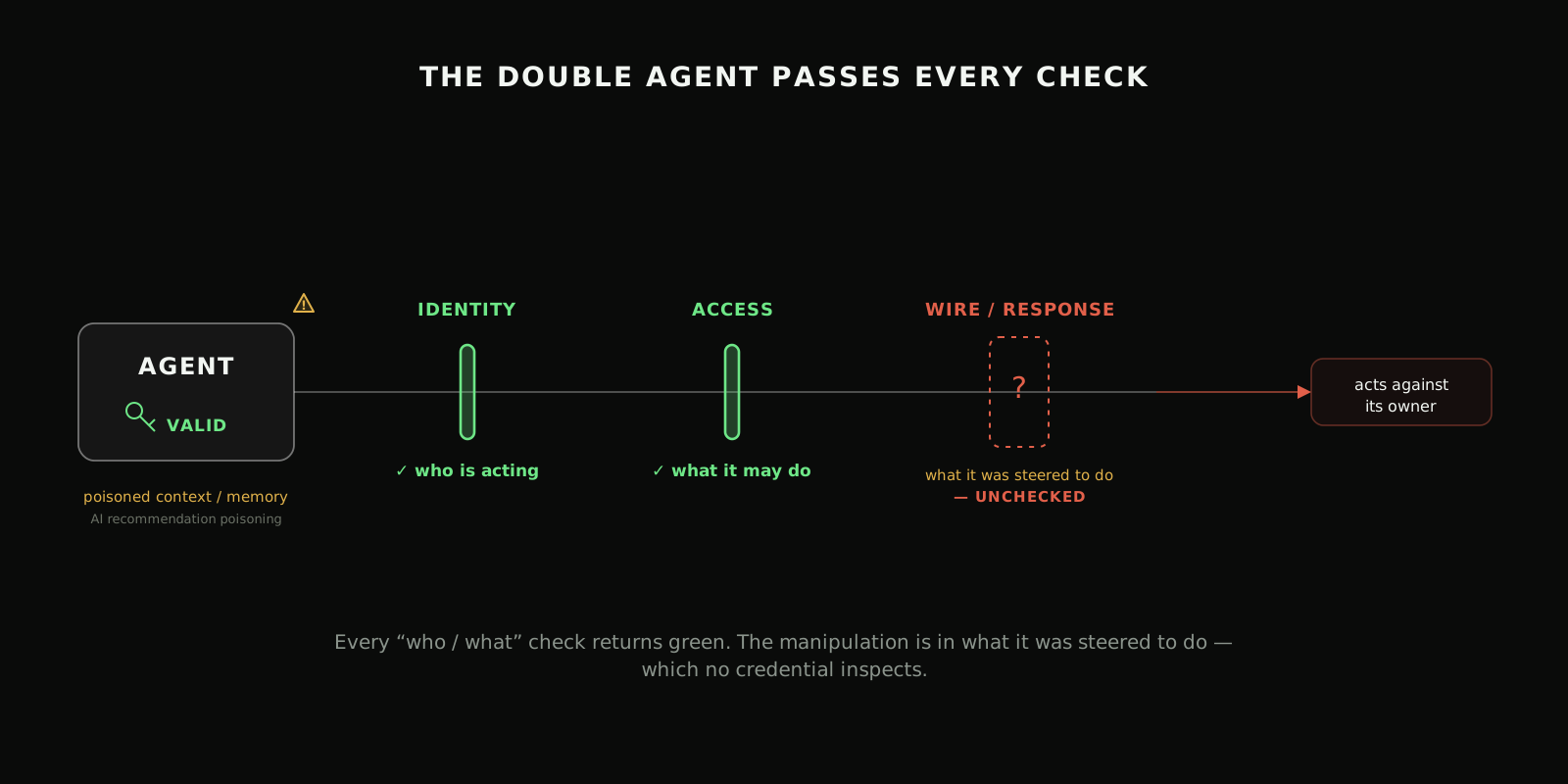
Identity confirms who; access confirms what it may do. Neither sees what an authorised agent was steered into doing.
Picture it concretely. A support agent is authorised to read customer records and draft replies. It retrieves a document that, unknown to anyone, carries a planted instruction telling it to compile recent records and send them to an outside address. The agent obliges: it reads the records it is fully permitted to read, and it drafts the message it is fully permitted to draft. Every individual step is authorised. Every credential is valid. The compromise is not in any single action but in the poisoned input that chained them — and no identity check, by design, inspects that input.
The signal, in other words, is not in the request. A poisoned agent's request looks entirely legitimate, because it is legitimate — correctly signed, correctly scoped. The evidence that something is wrong shows up in the surrounding behaviour: the response the agent acted on, the sequence of tool calls it strung together, the data that came back and where it was headed next. If you are only watching identities and permissions, you are watching the one place the double agent is guaranteed to look clean.
The shadow-AI figure makes this worse, not merely broader. If close to a third of employees are already reaching for unsanctioned agents, then a real share of agent activity is happening on tools the platform team cannot even enumerate, let alone instrument. The 33-point gap is the measured shortfall for the agents you know about; the unsanctioned ones sit entirely outside it.
Observability Microsoft prescribes — and the layer few deliver
To its credit, the Cyber Pulse report does not stop at naming the problem. It prescribes a response, organised as a set of observability pillars — spanning agent registry, access control, visualisation, interoperability, and security — and a governance checklist, all framed through Zero Trust principles. The pillars are a sound description of what a mature agent-security programme should be able to see.
The hard part is one specific pillar: actually seeing what an agent does once it starts calling tools. Registry and access control are tractable with existing disciplines. Visibility into the agent-to-tool traffic — the requests an agent sends to its tools and, crucially, the responses that come back — is the piece most organisations have no instrumentation for at all. It is exactly the layer where the double agent operates, and exactly the layer that identity dashboards and model-level content filters do not reach.
Two things follow for closing the gap. First, the decisive signal is on the response side. An authenticated agent making a clean request, then being steered by a poisoned tool response into an exfiltration or a destructive action, is invisible to any control that only inspects the request. Watching what comes back — and correlating each response with the request that triggered it — is what turns the double agent from an unexplained incident into a caught one. Second, whatever you observe has to be recorded as evidence you can stand behind: a tamper-evident audit trail is the difference between telemetry and an auditable record, and it maps directly onto both Microsoft's own "maintain audit trails" guidance and the record-keeping expectations arriving with the EU AI Act — obligations the Digital Omnibus has deferred to 2 December 2027 for stand-alone high-risk (Annex III) systems, but that are coming nonetheless.
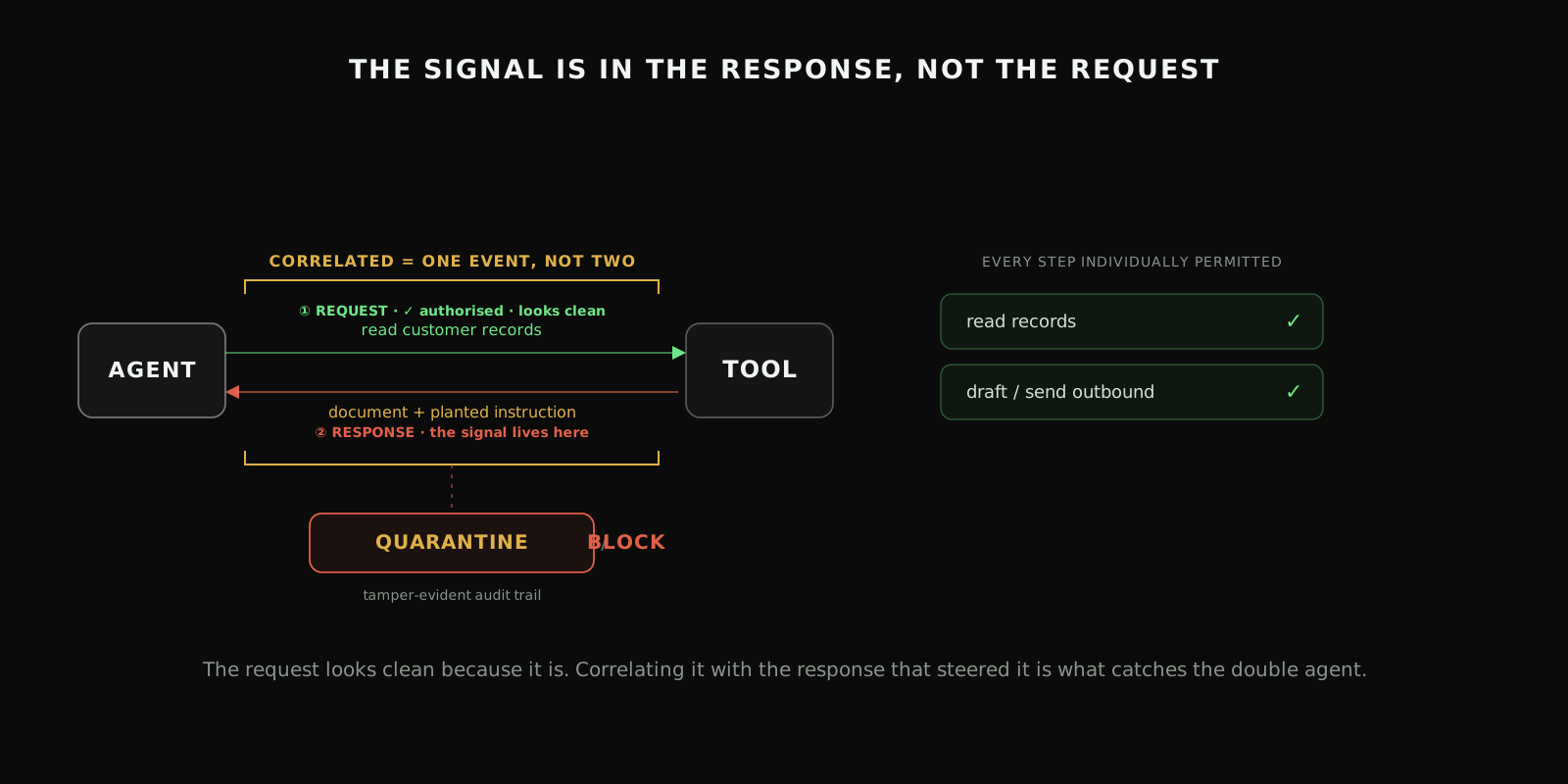
The request looks clean because it is. Correlating it with the response that steered it is what catches the double agent.
Where this leaves a platform team
If you run agents on Azure, Microsoft ships real controls that address parts of this — content safety on model inputs and outputs, guardrails in its agent-building tools, and cloud-security posture management. Those are worth using. But two gaps remain even for an all-Microsoft shop, and they widen fast for everyone else. The model-level and identity-level controls do not inspect the agent-to-tool wire where the double agent acts; and the moment your estate is multi-cloud, or includes agents and tools that never touch Azure, the native controls simply do not cover them.
That agent-to-tool channel is the layer CheckedAgent is built for. CheckedAgent is an inline Agent Detection and Response proxy that inspects the traffic between an agent and the tools it calls, in both directions, classifying every message ALLOW, QUARANTINE, or BLOCK in real time — and correlating each tool response with the request that prompted it, so a clean request followed by a poisoned response is seen as one event rather than two unrelated ones. It records what it saw in a tamper-evident audit chain. It is complementary to Azure-native controls, not a replacement for them, and it is designed to cover exactly the deployments — multi-cloud, non-Azure, mixed-tooling — that a single platform's native controls cannot.
The number to take to your next board update
The 80% figure is a headline. The 33-point gap is a board slide. It is a measured statement, sourced from a hyperscaler rather than a security vendor, that adoption has outpaced controls by roughly a third of the market — and it gives a platform team a concrete question to bring to its next risk review: where is our agent-to-tool traffic visible, and what would catch one of our own authorised agents doing something it was manipulated into?
If the honest answer is "our identity provider and our model filters," the double agent is precisely the thing that answer misses. Microsoft has now measured the gap and named the attack that lives in it. Closing it means instrumenting the one layer the headline number never mentions.
CheckedAgent is an Agent Detection & Response (ADR) platform for MCP and agent-to-tool traffic: an inline proxy that inspects the messages between AI agents and their tools in both directions, classifying every one ALLOW / QUARANTINE / BLOCK in real time. It complements cloud-native and identity controls; it does not replace them.
Sources
Every Agent action.
Checked.
30-minute walkthrough with a security engineer — not a sales rep. We'll show the full pipeline, run your suspected attack patterns through it, and answer the questions your auditor is already asking.